
Culture Scheduler

Run multi-week cell culture protocols on a robotic workcell, down to the wells you choose.
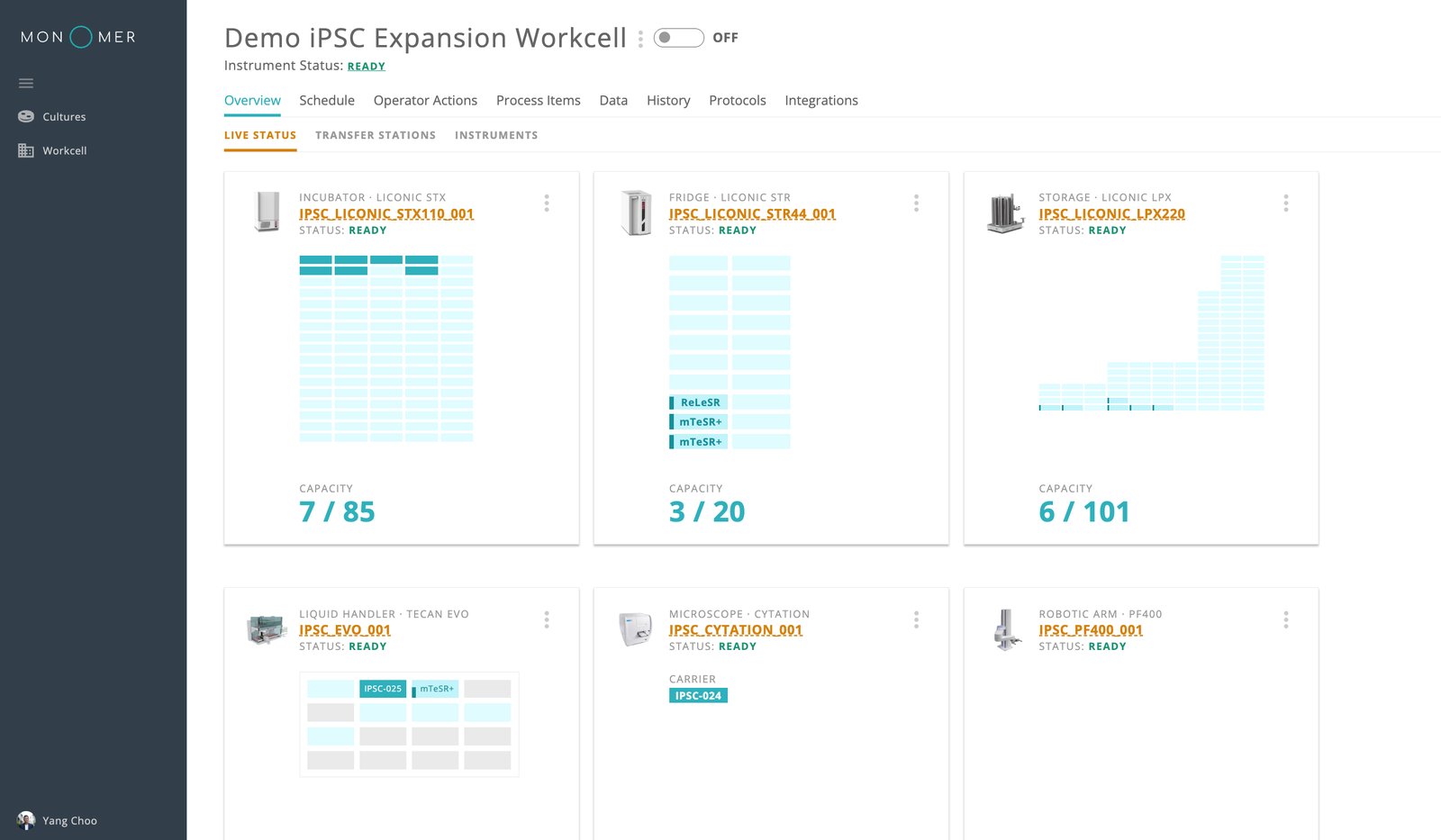
Workcell overview: iPSC plates in the incubator, mTeSR+ and ReLeSR in the fridge, tip racks in the plate hotel, a plate and media on the liquid handler deck, and a plate on the imager carrier
Plan

Protocols that run for weeks

Describe a protocol once: which routines run, in what order and how far apart. The scheduler gives every routine a date and time, and tracks each one from start to finish.
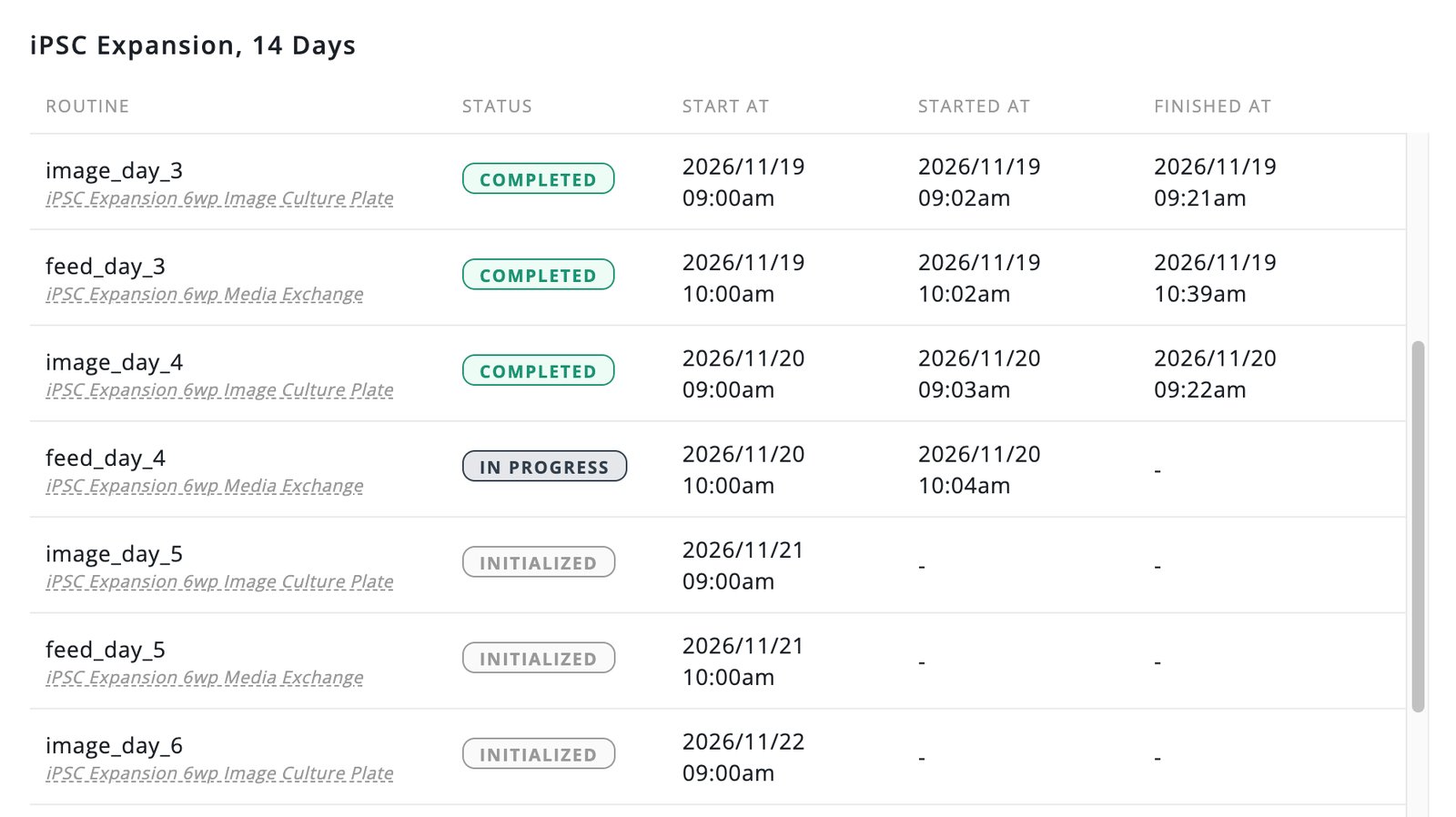
Day 4 of a 14-day iPSC expansion run: earlier imaging and feeds completed with start and finish times, today's feed in progress, and the next days scheduled
Control

Act on single wells

Feed or passage only the wells you pick, not the whole plate. The workcell tracks every well, and a well marked terminated is left out of later feeds.
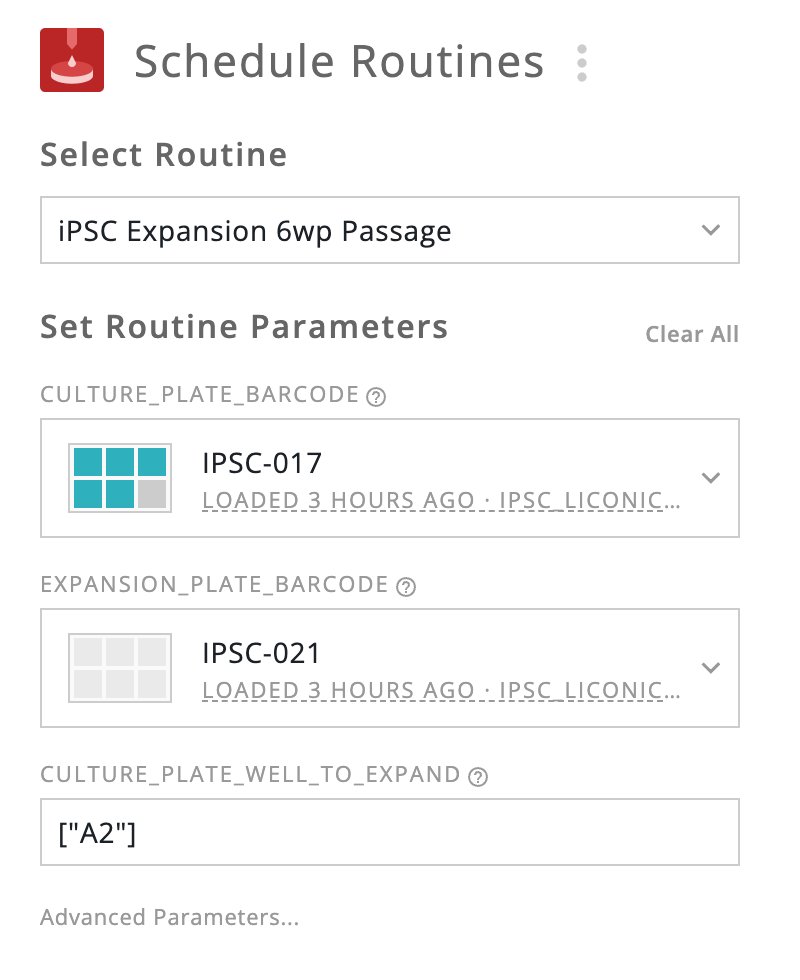
Scheduling a passage of well A2 only, from plate IPSC-017 into the empty plate IPSC-021. The IPSC-017 plate map shows well B3 greyed out as terminated
Run

See every step before it runs

Each routine is planned down to every instrument and robot move before it starts, from fetching media out of the fridge to warming it on deck. When the next day's routines are short of consumables, you hear about it on Slack.
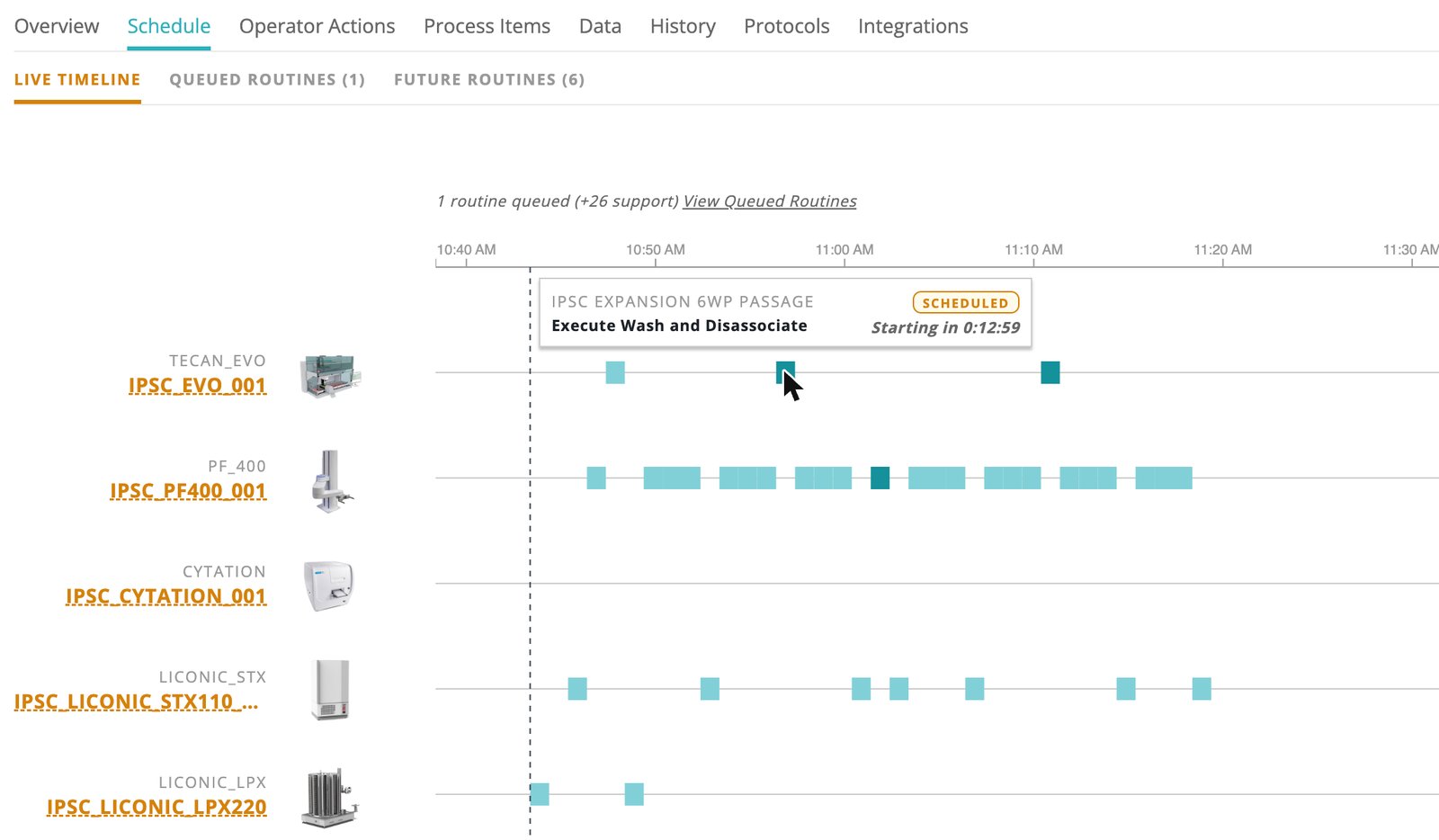
Live timeline of a queued passage across the liquid handler, robot arm, imager, incubator and plate hotel, with the pointer on the wash and dissociate step
Program

Protocols as code

A protocol is a short Python file. Loops lay out weeks of imaging and feeding in a few lines, and timing rules keep each feed an hour after that morning's image. Protocols live in version control, and AI coding tools can help write them.

hepatocyte_differentiation.py
def build_definition(plate):
    workflow = WorkflowDefinitionDescriptor()
    image = RoutineReference(⋯)

    # Image every morning for 20 days
    images = [workflow.add_routine(f"image_{day}", image)
              for day in range(1, 21)]
    workflow.space_out_routines(images, Time("1 day"))

    # Switch media as the cells differentiate
    for media, days in [⋯ 4 media]:
        for day in days:
            workflow.add_routine(f"feed_{day}", ⋯)
            workflow.add_time_constraint(MoreThanConstraint(⋯))
    return workflow
Close the loop

Passage when the cells are ready

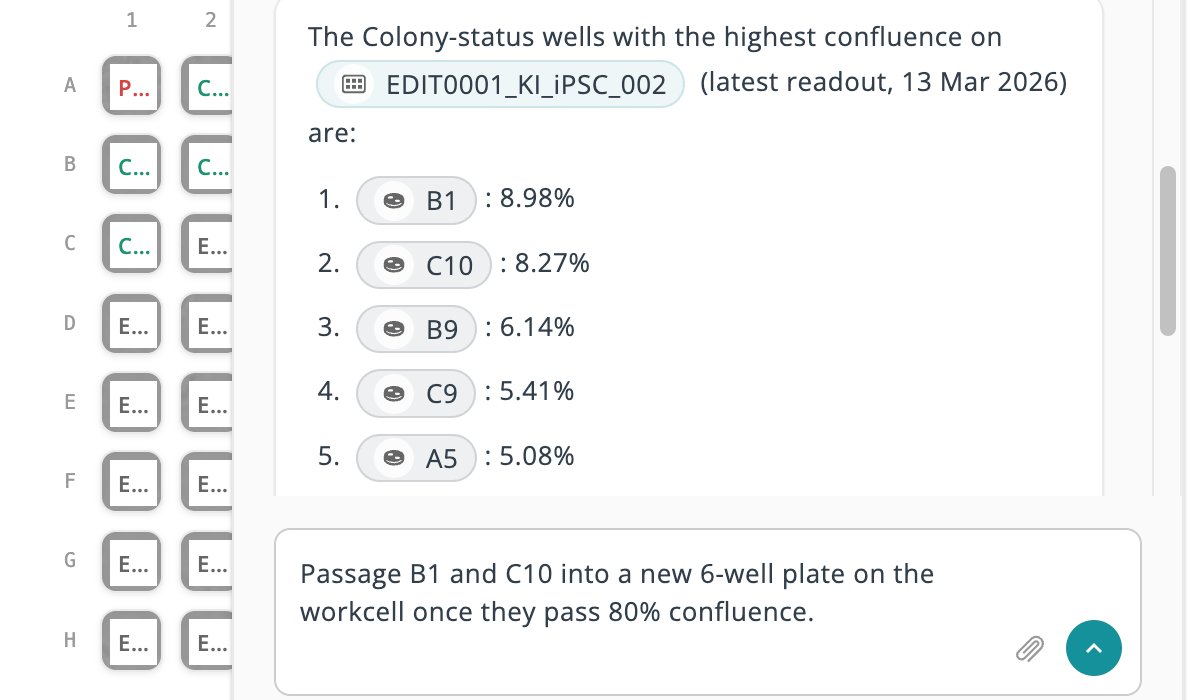
Plates imaged on the workcell land in Culture Monitor. Ask the Assistant to check confluence and passage the wells that are ready. The request goes to the workcell, where an operator approves it before it runs.
Explore Culture Monitor
The Culture Monitor Assistant beside an iPSC cloning plate, listing the colony wells with the highest confluence, with a follow-up prompt asking it to passage B1 and C10 into a new 6-well plate on the workcell once they pass 80% confluence
Workcells we build

Start from a workcell set up for common cell culture work

iPSC expansion

Daily feeding, brightfield imaging and passaging.

More than 10x the throughput of a manual operator

Stem cell differentiation

Complex feeding schedules and brightfield imaging, across dozens of overlapping multi-week protocols.

Tens of thousands of images per week

Organoid differentiation

Month-long protocols with feeding, imaging and brightfield video, and no weekend shifts.

Under 6 weeks to production runs

See hardware reference designs
Results

Organoids at scale in 6 weeks

Six weeks after hardware delivery, Rosebud Biosciences was growing iPSC-derived hepatic organoids at scale on its Monomer workcell.

Confocal image of a whole iPSC-derived hepatic organoid stained for albumin, CK19, CD31 and nuclei, beside a higher-magnification close-up of its cells

Hepatic organoid grown by Rosebud Biosciences, stained for albumin (ALB), CK19, CD31 and DAPI.

Instruments

Built from instruments you can buy today

Pick the instruments that fit your biology, and add to the workcell as your work changes.

Liconic incubators
Opentrons OT-2 and Flex
Tecan EVO and Infinite
Precise Automation PF400
Agilent BioTek Cytation
Yokogawa CQ1
Nikon Ti2-E
Cephla Squid
BMG FLUOstar Omega
Nexcelom Cellaca and Cellometer
Nova Biomedical FLEX2
Thermo Fisher Attune NxT
Agilent VSpin
How we work

We stay until your cells are growing

1

Design

Our automation specialists learn your workflow, pick the hardware and design the workcell with you.

2

Build and validate

We install, configure and qualify the workcell in your facility, and support you until your cells grow as they should.

3

Keep improving

We check in regularly and add routines and instruments as your work changes.

Plan your workcell with us

Tell us what you culture and how often you feed, image and passage. We will show you how it would run.